Home/Books/What Job Adverts Actually Mean
What They Actually Mean
What Job Adverts Actually Mean
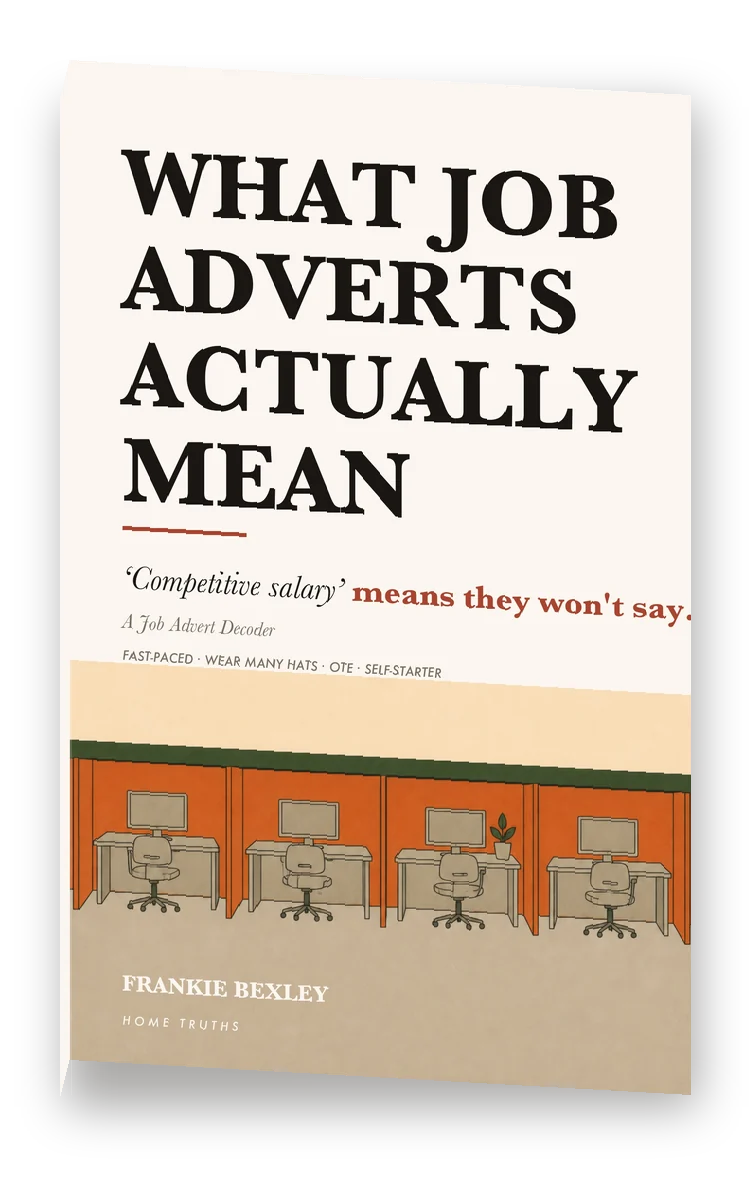
A Job Advert Decoder: Competitive Salary, Fast-Paced, Wear Many Hats and the Rest of the Recruitment Phrasebook
- Author
- Frankie Bexley
- Pages
- 57
- Paperback
- £7.99
- Ebook
- £2.99
- Published
- Not yet
Not out yet. This page exists so the work is visible while it is being made, which is more honest than a placeholder.
A job advert has to attract you and commit to nothing, and the whole vocabulary lives in the gap between those two jobs. Forty-five phrases decoded, from competitive salary to other duties as required, each with the question to ask before you apply rather than after.
What is in it
- The years you could have been born, and what a house, a week of work and a pound actually cost in each of them.
- What has changed since, with the figures rather than the sighing.
- The honest bits about the age, written by somebody not pretending it is fine.
- Quizzes and things to argue about.
- Things you can now say and get away with.
- Around forty pages to fill in, which is the part that survives.
Formats and price
| Format | Price | Why |
|---|---|---|
| Hardback | To come | The gift version. Survives being kept. |
| Paperback | £7.99 | The one most people buy. |
| Ebook | £2.99 | Read it, but you cannot write in it. |
Part of What They Actually Mean, an Home Truths series.
Frequently asked
- What does competitive salary actually mean?
- It means they are not telling you the number. It is not a claim about the salary being high; it is the absence of a claim, and the honest response is to ask for the range before the first interview rather than after the second.
- Is this cynical about employers?
- No. Almost every phrase in the book exists for a reason, and several of them are the employer being careful rather than evasive. The book says which is which, because treating all of it as a con is as useless as taking all of it at face value.
- Will it help me write a job advert as well as read one?
- It is written for the reader rather than the writer, but the entries work in reverse. If you are advertising a role and every line of your advert appears in this book, the advert is telling candidates nothing.
- Does it work outside the UK?
- Mostly, yes. The vocabulary of recruitment is close to identical across English-speaking markets, which is why this is one of the two decoders where almost nothing needed changing.